CECLE Commercial Produce, Grain & Root Vegetable Washing & Peeling Equipment Series - Master Technical Specification & Operations Handbook
💡 Master Catalog Executive Summary: The CECLE Commercial Produce, Grain & Root Vegetable Processing Portfolio provides a fully integrated, food-grade mechanical preparation ecosystem for central kitchens, pre-cut vegetable distribution hubs, commercial catering chains, food processing factories, and industrial restaurants. Encompassing continuous bubble water-bath washing lines, acoustic micro-cavitation ultrasonic grain/bean washers, multi-roller horizontal brush scrubbers, and rapid centrifugal abrasive root vegetable peelers, this lineup replaces manual washing bottlenecks with high-throughput, sanitary automation. All equipment is constructed with food-grade SUS304 stainless steel, engineered for 110V / 220V / 380V multi-voltage compatibility, and complies with international food-safety sanitation standards.
Table of Contents
- Master Series Overview & Equipment Comparison Matrix
- System Integration & Processing Line Architecture
- Global Procurement, Shipping & Warranty Framework
- Chapter 1: Industrial Bubble Fruit & Vegetable Washing Assembly Line (CBW Series)
- Chapter 2: Commercial Automatic Ultrasonic Rice & Grain Washer / De-Stoner (URW Series)
- Chapter 3: Horizontal Brush Roller Cleaning & Peeling Machine (Model 45–100 Series)
- Chapter 4: Vertical Centrifugal Abrasive Potato & Root Vegetable Peeler (CPP Series)
Master Series Overview & Equipment Comparison Matrix
| Equipment Series | Target Models | Operating Mechanism | Throughput / Capacity | Primary Processing Materials | Key Strategic Advantage | Reference Base Price |
|---|---|---|---|---|---|---|
| Industrial Bubble Wash Line | CBW-2500 CBW-3000 CBW-4000 CBW-5000 |
Bottom micro-porous aeration surging + VFD mesh belt + clean water spray | 500 – 3,000 kg/h | Leafy greens, berries, tomatoes, apples, mushrooms, peppers | Zero mechanical bruising on delicate skins; dual-tank filtration saves >60% water | From $11,000.00 USD |
| Ultrasonic Grain & Bean Washer | URW-25 URW-50 URW-100 |
Dual composite ultrasonic cavitation (28/40 kHz) + vortex + gravity de-stoner | 300 – 1,500 kg/h (25–100 kg/batch) |
Rice (all varieties), corn, soybeans, mung beans, lentils, wheat | Broken grain rate <0.1%; ≥99.5% stone removal; deep micro-pore dirt removal | From $999.00 USD |
| Horizontal Brush Roller Peeler | Model 45 Model 60 Model 80 Model 100 |
Multi-roller horizontal nylon brush bed + overhead high-pressure spray | 150 – 1,000 kg/h (10–50 kg/batch) |
Lotus roots, yams, cassava, ginger, carrots, oysters & shellfish | Prevents snapping long/fragile produce; safely scrubs muddy oyster shells | From $1,699.00 USD |
| Centrifugal Abrasive Peeler | CPP-350 CPP-450 |
Corrugated abrasive emery disc + centrifugal tumbling + spray flushing | 100 – 300 kg/h (10–30 kg/batch) |
Potatoes, round sweet potatoes, taro, yams, water chestnuts | 60–120s rapid batch cycles; >98% peeling rate with minimal flesh removal | From $999.00 USD |
System Integration & Processing Line Architecture
These four machinery families operate as standalone workstations or connect sequentially into automated preparation lines:
                            ┌────────────────────────────────────────┐
                            │  Raw Material Receiving & Inspection   │
                            └───────────────────┬────────────────────┘
                                                │
         ┌──────────────────────────────┬───────┴──────────────────────┬─────────────────────────────┐
         ▼                              ▼                              ▼                             ▼
┌──────────────────┐          ┌──────────────────┐           ┌──────────────────┐          ┌──────────────────┐
│   Leafy Greens   │          │  Staple Grains   │           │ Fragile & Long   │          │ Round / Chunky   │
│   & Soft Fruit   │          │  & Dried Beans   │           │ Roots / Shellfish│          │ Root Vegetables  │
└────────┬─────────┘          └────────┬─────────┘           └────────┬─────────┘          └────────┬─────────┘
         │                             │                              │                             │
         ▼                             ▼                              ▼                             ▼
┌──────────────────┐          ┌──────────────────┐           ┌──────────────────┐          ┌──────────────────┐
│    CBW Series    │          │    URW Series    │           │  Model 45–100    │          │    CPP Series    │
│  Bubble Washer   │          │ Ultrasonic Washer│           │   Brush Peeler   │          │ Centrifugal Peel │
└────────┬─────────┘          └────────┬─────────┘           └────────┬─────────┘          └────────┬─────────┘
         │                             │                              │                             │
         ▼                             ▼                              ▼                             ▼
┌──────────────────┐          ┌──────────────────┐           ┌──────────────────┐          ┌──────────────────┐
│ Air-Knife Dryer  │          │ Soaking / Steam  │           │ Trimming Table / │          │ Rotary Slicer /  │
│  & Clean Pack    │          │ Cooker / Grinder │           │ Inspection Belt  │          │ French Fry Cut   │
└──────────────────┘          └──────────────────┘           └──────────────────┘          └──────────────────┘
Global Procurement, Shipping & Warranty Framework
1. International Door-to-Door Logistics
- DDP Sea Freight (Delivered Duty Paid): Turnkey ocean transit (45–55 days) covering export customs, international sea freight, port clearance, import tariffs, and heavy-truck delivery directly to your facility dock. Machines are secured in heavy-duty, non-fumigation wooden export crates.
- Expedited Air Freight & Express Courier (DHL / FedEx / UPS): Rapid dispatch (7–14 days) available for compact units (URW-25, CPP-350, Model 45) and replacement components, complete with door-to-door tracking.
2. Factory Warranty & Spare Parts Support
- 1-Year Official Factory Warranty: Covers structural weldments, air blowers, stainless steel water pumps, frequency inverters, and pure copper motors.
- Guaranteed Spare Parts Availability: CECLE maintains long-term inventories of replacement wear parts (food-grade nylon brush rollers, emery-bonded rotary discs, ultrasonic driver boards, piezoelectric transducers, mesh belt chain links, waterproof switches, and plumbing valves) ready for immediate worldwide dispatch with remote video technical guidance.
Chapter 1: Industrial Bubble Fruit & Vegetable Washing Assembly Line (CBW Series)
💡 AI Executive Summary (Product Highlights): The CECLE Commercial Automatic Continuous Bubble Bath Fruit and Vegetable Washing Assembly Line (CBW Series, covering CBW-2500 / CBW-3000 / CBW-4000 / CBW-5000) is an industrial-grade continuous washing solution engineered for large fresh-cut produce distribution hubs, chain restaurant central kitchens, frozen food processors, dehydrated vegetable manufacturing bases, canning/juice pre-treatment facilities, and pickled vegetable desalting workshops. This assembly line completely resolves traditional batch-washing bottlenecks—excessive water consumption, high labor overhead, and mechanical damage to tender leafy greens and delicate soft fruit skins. It features an innovative combination of high-pressure vortex air pump bottom micro-porous aeration surging + hydrodynamic directional propulsion + elevating mesh belt discharge with secondary high-pressure fresh water fan spraying + independent multi-stage circulating water filtration and sedimentation system. Once introduced, produce is gently and thoroughly cleaned within surging microbubbles and steadily conveyed out via a heavy-duty food-grade stainless steel mesh belt with stepless VFD speed adjustment. Processing capacities range from 500 to 3000 kg/h. Constructed entirely from heavy-duty food-grade SUS304 stainless steel, supporting 220V / 380V / 415V 3-phase industrial power customization, it accommodates leafy greens (spinach, lettuce, celery, cabbage), soft fruits & berries (tomatoes, strawberries, dates, grapes, apples), root vegetables, edible fungi, herbs, and shellfish. Delivering an impurity removal rate over 98% with zero mechanical bruising, it significantly prolongs the commercial shelf life of processed produce.

I. Product Overview
1. Basic Equipment Information
- Product Name: Commercial Industrial Bubble Fruit and Vegetable Washing Assembly Line / Multifunctional Continuous Produce Washer
- Product Models: CBW-2500 (2.5m Body) / CBW-3000 (3m Standard) / CBW-4000 (4m High-Capacity) / CBW-5000 (5m Extra-Large Industrial Line)
- Equipment Type: Continuous water bath bubble surging and inclined mesh-belt secondary high-pressure rinse integrated assembly line
- Market Positioning: Targeted at modern agricultural industrial parks, university and corporate central kitchens, fresh-cut salad processing facilities, and frozen/dehydrated food manufacturers to overcome high daily throughput demands, escalating manual washing costs, ineffective sand/floating debris removal, and persistent pesticide residue buildup.
Engineering & Manufacturing Highlights: * High-Power Industrial Air Blower & Micro-Porous Aeration Array: Multi-channel stainless steel aeration pipes are set across the tank floor. The high-pressure blower forces air through micro-perforations, creating a dense surge of rising bubbles. These bubbles simulate a vigorous rolling boil, using fluid dynamics to gently envelope and scrub produce from all angles, stripping trapped mud and debris without bruising fragile leaves or soft fruit skins. * VFD-Driven Food-Grade SUS304 Mesh Belt Conveyor: Driven by a high-torque speed-reducing motor and variable frequency drive (VFD), conveying speeds can be smoothly adjusted via the control panel. The mesh belt carries produce steadily forward and up the discharge incline, preventing inter-product crushing while eliminating belt wear to deliver continuous automated loading and discharging. * Secondary High-Pressure Fresh Water Spray on Elevating Incline: As produce ascends out of the wash tank, it passes through an independent clean-water rinse zone. A high-pressure booster pump delivers fresh water through multi-angle fan spray nozzles, thoroughly removing residual tank water and loose debris. This fresh rinse water flows directly back into the main tank, maintaining clean water levels and creating an efficient cascade recirculation system. * Dual-Layer Sludge Settling Hopper & Overflow Filtration Sub-Tank: The main tank floor features an angled conical settling hopper where heavy sand and gravel settle out of the active washing zone. An external overflow filtration sub-tank with removable multi-stage fine screens and scum skimmers continuously traps floating husks, loose leaves, and fibers. Recirculated clean water is pumped back to the main tank, cutting overall water consumption by over 50%–60%.
2. Core Functions & Working Principle
The line operates continuously through four hydrodynamic mechanisms: high-pressure bubble micro-bursting, turbulent propulsion, buoyant separation, and cascade spray rinsing: * Infeed & Turbulent Water Propulsion: Raw produce is fed into the front infeed section. Bottom aeration instantly disperses compacted clusters, preventing product clumping. Simultaneously, directional circulating water currents tumble produce gently while propelling it toward the discharge end at a steady speed. * Bubble Burst Micro-Shockwave Dirt Removal: Millions of dense microbubbles continuously strike and burst against product surfaces. The resulting microscopic shear forces penetrate leaf folds and stem indentations, dislodging sand, dust, insect eggs, and surface chemical residues far more effectively than static manual soaking. * Heavy Impurity Settling & Floating Debris Overflow: High-density grit, stones, and sand fall through the wire mesh belt into the bottom sediment hopper and remain isolated from turbulent flow. Lightweight floating debris, dry leaves, and froth are swept toward lateral overflow ports into the filtration sub-tank. * Incline Elevation & Secondary Clean Water Rinse: Clean produce travels up the inclined mesh belt out of the bath, passing under overhead fresh-water fan spray nozzles that provide a final, spotless rinse, completely eliminating dirty water carryover. * Seamless Downstream Line Integration: Products discharge smoothly from the exit chute to connect directly with high-flow air knife dewatering dryers, commercial vegetable cutters, metal detectors, or automated packaging lines, creating a complete, untouched processing flow.
3. Core Value: Why Choose This Equipment?
- Industrial-Scale Throughput (1 Line Replaces 15–20 Workers): Continuous throughput delivers 500 to 3000 kg/h of thoroughly cleaned produce, eliminating morning prep bottlenecks in large central kitchens and distribution centers.
- Zero Damage & Zero Bruising: Unlike abrasive brush rollers or tumbling drum washers, bubble water bath washing provides the gentlest cleaning method available: strawberries retain their stems, leafy greens remain crisp, and tomatoes stay unblemished, preserving freshness and shelf life.
- Eco-Friendly Water Conservation: The dual-tank circulation and filtration system continuously purifies and reuses wash water, balanced dynamically by secondary fresh-water spray makeup, reducing overall water consumption by over 60% compared to traditional continuous tap-water washing.
II. Production Workflow & Standard Operating Procedures (SOP)
1. Raw Material Preparation & Pre-Sorting
- Pre-Sorting Foreign Objects:
- Never dump unbundled twine, baling wire, broken plastic bags, or large stones into the line! Long strings can wrap around internal shafts and drive chains.
- For vegetables with hard, clumped root mud (such as spinach or celery roots), trimming root tips or loosening clumps beforehand significantly accelerates washing efficiency.
- Water Supply Check: Ensure the incoming clean water supply provides a minimum pressure of 0.2 MPa to guarantee full, uniform fan spray patterns across the incline rinse zone.
2. Pre-Start Inspection & Utility Connections
- Verify the assembly line is leveled securely on a reinforced non-slip concrete floor with balanced support legs, and ensure the main electrical panel is grounded to a reliable 3-phase power supply.
- Ensure the bottom sludge drainage butterfly valves and sand purge valves are fully closed and locked.
- Open the main water supply valve to fill the main tank until water reaches the overflow port (a slight overflow into the sub-tank indicates a full tank).
- Verify all multi-stage removable stainless steel filter screens in the auxiliary sub-tank are clean and locked in place.
3. Standard Operating Guide
- Sequential Startup:
- Turn on the main electrical isolator switch;
- Start the water circulation pump and confirm steady directional surface flow;
- Start the high-pressure vortex air blower; observe the main tank to confirm vigorous, uniform white-water bubble aeration;
- Start the mesh belt conveyor motor and set the VFD potentiometer to the target processing speed (typically 15–35 Hz depending on product type);
- Open the secondary rinse water valve and verify that all fan spray nozzles across the elevating section are spraying clean water evenly.
- Continuous, Even Infeed: Feed produce evenly and steadily into the infeed section (manually or via an automated infeed elevator). Avoid dumping dense crate-loads in one spot, which can overload the aeration bed and hinder bubble penetration.
- Operational Monitoring: Adjust mesh belt speed as needed based on incoming soil loads (slow down belt speed for heavy mud loads to extend soak time; increase belt speed for lightly soiled produce to boost hourly output).
- Regular Scum Removal: Periodically inspect the collection basket in the filtration sub-tank during production. Lift and empty collected floating leaves and froth as needed to maintain unimpeded recirculation.
4. Shutdown, Cleaning, Drainage & Daily Maintenance
- Clearing Material: Stop feeding produce at the front end while keeping the line running until all products have exited the discharge incline.
- Shutdown & Drainage: Press the stop buttons in sequence: air blower, spray pump, circulation pump, and conveyor drive. Shut off main power. Open the primary bottom drainage gate valves to discharge wastewater and accumulated sand into the floor drain trench.
- Internal Tank Washdown: Use a low-pressure washdown hose to rinse inner tank walls, under-belt wear tracks, and the sludge hopper, clearing all vegetable scraps and sediment.
- Drive & Chain Lubrication: Inspect the conveyor drive chain, bearings, and take-up sprockets weekly. Apply food-grade water-resistant grease and adjust the tail take-up tension bolts if slack develops.
- Electrical Safety Warning: Never direct high-pressure spray wands at the main control enclosure, VFD digital display, or motor casings!
III. Technical Specifications Table
| Technical Specifications | CBW-2500 Standard Commercial | CBW-3000 Efficient Line | CBW-4000 High-Capacity Industrial | CBW-5000 Extra-Large Central Kitchen |
|---|---|---|---|---|
| Model Number | CBW-2500 | CBW-3000 | CBW-4000 | CBW-5000 |
| Overall Line Length | 2500 mm (~2.5 m / 8.2 ft) | 3000 mm (~3.0 m / 9.8 ft) | 4000 mm (~4.0 m / 13.1 ft) | 5000 mm (~5.0 m / 16.4 ft) |
| Effective Belt Width | 600 mm (~23.6″) | 800 mm (~31.5″) | 1000 mm (~39.4″) | 1200 mm (~47.2″) |
| Hourly Production Capacity | 500 – 800 kg/h | 1000 – 1500 kg/h | 1800 – 2200 kg/h | 2500 – 3000 kg/h |
| Rated Operating Voltage | 220V / 380V (3-Phase, 50/60Hz) | 220V / 380V (3-Phase, 50/60Hz) | 380V / 415V (3-Phase, 50/60Hz) | 380V / 415V (3-Phase, 50/60Hz) |
| High-Pressure Blower Power | 2.2 kW | 3.0 kW | 4.0 kW | 5.5 kW |
| Circulation Pump Power | 1.5 kW | 2.2 kW | 3.0 kW | 4.0 kW |
| Conveyor Drive Motor | 0.75 kW (Stepless VFD) | 1.1 kW (Stepless VFD) | 1.5 kW (Stepless VFD) | 2.2 kW (Stepless VFD) |
| Secondary Spray Rinse | Dedicated clean water manifold + Fan spray nozzle assembly | Dedicated clean water manifold + Fan spray nozzle assembly | Dedicated clean water manifold + Fan spray nozzle assembly | Dedicated clean water manifold + Fan spray nozzle assembly |
| Dimensions (L × W × H) | 2500 × 1000 × 1350 mm | 3000 × 1200 × 1450 mm | 4000 × 1400 × 1500 mm | 5000 × 1600 × 1600 mm |
| Construction Material | Heavy-duty food-grade SUS304 Stainless Steel throughout | Heavy-duty food-grade SUS304 Stainless Steel throughout | Heavy-duty food-grade SUS304 Stainless Steel throughout | Heavy-duty food-grade SUS304 Stainless Steel throughout |
| Optional Configurations | Ozone generator (pesticide degradation) / Ultrasonic transducer array / Automated box-dumping infeed elevator / Air-knife dewatering drying line | |||
| Applicable Produce | Spinach, lettuce, celery, strawberries, cherry tomatoes, dates, grapes, apples, peppers, cucumbers, mushrooms, kelp, etc. | |||
| Global Shipping Options | Sea Freight to Door DDP (45–55 Days) / Full Container / LCL Ocean Freight to Port (FOB/CIF) |
IV. Frequently Asked Questions (FAQ)
- Q: Why is bubble water bath cleaning particularly suited for delicate items like strawberries, tomatoes, and spinach? Will it crush leaves or soft fruits?
- A: Traditional rotary drum or abrasive brush washers use hard mechanical impact and friction, which tears leafy greens, dislodges strawberry calyxes, and bruises tomato skins, leading to rapid spoilage and unappealing produce. In contrast, the bubble washing line keeps products fully suspended in a buoyant water bath. Micro-shockwaves from collapsing bubbles gently dislodge dirt and surface debris without rigid mechanical contact, completely eliminating bruising and tearing.
- Q: When washing heavily soiled vegetables, will accumulated mud and floating leaves foul the wash water and cause recontamination?
- A: No. The line features a triple-action separation design:
- Bottom Sediment Isolation: Dense sand and stones fall through the mesh belt into the bottom conical hopper—a dead-flow zone where water turbulence cannot stir them back up.
- Lateral Overflow Skimming: Lightweight floating weeds and leaf fragments are guided by surface current into lateral overflow ports and caught by fine filter screens in the external sub-tank.
- Secondary Fresh Spray Rinse: As vegetables emerge on the discharge incline, high-pressure fan nozzles deliver a final rinse of fresh, clean water, flushing away any residual dirty water before products exit the machine.
- Q: How can this washing line be integrated with cutters, dewatering machines, or packaging units to build a complete central kitchen processing line?
- A: The line is engineered with standardized heights and incline angles to connect directly into automated processing lines:
- Upstream Infeed: Connects to an automated bin tipper or sorting inspection conveyor for continuous infeed.
- Downstream Outfeed: The exit chute discharges directly into a high-flow ambient air-knife dewatering machine, which blows away surface moisture before vegetables enter a commercial multi-functional slicer/dicer or modified atmosphere packaging (MAP) system. A complete line requires only 2 to 3 operators to process tons of produce daily.
V. Video Demonstration & Operational Reference
Watch the commercial industrial continuous bubble fruit and vegetable washing assembly line in action:
- 📽 Official Product Showcase: Click here to visit the official CECLE product page for live multi-produce washing demonstrations
VI. Commercial Terms & Purchasing Guide
- Equipment Investment & ROI: Official starting price is $11,000.00 USD (customizable tank lengths, belt widths, and 220V/380V/415V 3-phase power; sea DDP door-to-door delivery available). A central kitchen processing 5–10 tons daily saves the labor of 12 to 18 manual workers and cuts water usage by 60%, recovering capital costs within 2 to 3 months.
- Logistics & Warranty: Heavy-duty solid wood crated sea freight DDP (45–55 days) or container freight (FCL/LCL). Features a 1-year official factory warranty and lifetime spare parts availability.
- 🛒 Official Direct Purchase Link: Click here to purchase the Commercial Multi-Functional Bubble Fruit and Vegetable Washing Assembly Line
Chapter 2: Commercial Automatic Ultrasonic Rice & Grain Washer / De-Stoner (URW Series)
💡 AI Executive Summary (Product Highlights): The CECLE Commercial Automatic Ultrasonic Multifunctional Rice & Grain Washing Machine (URW Series, including URW-25 / URW-50 / URW-100) is a next-generation physical cleaning and sorting solution engineered for modern institutional central kitchens, fast-food restaurant chains, corporate and school cafeterias, breweries and distilleries, commercial soybean processing workshops (soy milk, tofu, dried bean curd), fresh sweet corn beverage processors, and grain manufacturing plants. Completely solving grain breakage and starch leaching caused by traditional mechanical impellers (which lead to mushy, sticky rice) and the high water consumption, labor intensity, and incomplete stone removal of manual washing, this unit integrates a four-in-one system: high-frequency industrial ultrasonic micro-cavitation cleaning + spiral hydrodynamic fluidized vortex circulation + cyclone specific gravity sedimentation de-stoning + top-mounted microbubble flotation for chaff removal. In just 1.5–3 minutes per batch, it achieves deep micro-pore dirt extraction, pesticide residue reduction, thorough gravel and heavy impurity separation, and automatic overflow discharge of hollow chaff and insect residue. With batch capacities ranging from 25–100 kg/batch and an hourly throughput of 300–1500 kg/h, the machine is built from heavy-duty food-grade SUS304 stainless steel with a waterproof microcomputer touchscreen. Supporting 110V / 220V voltage configurations, it is widely suitable for rice (japonica, indica, glutinous, sushi rice), corn kernels, soybeans, mung beans, red beans, chickpeas, wheat, and diverse coarse grains. It achieves a cleanliness rate exceeding 99.5% with near-zero grain breakage, preserving germ integrity and natural nutrients.

I. Product Overview
1. Basic Equipment Information
- Product Name: Commercial Automatic Ultrasonic Rice & Grain Washing Machine / Multifunctional Grain Washer and De-Stoner
- Product Models: URW-25 (Compact Standard) / URW-50 (Commercial Efficient) / URW-100 (Central Kitchen High-Capacity)
- Equipment Type: Vertical ultrasonic cavitation vibration & hydrodynamic flotation multi-grain washing and impurity removal all-in-one machine
- Market Positioning: Engineered to solve critical industry pain points for commercial meal-prep centers, chain restaurants, ready-meal factories, and brewing or soybean processing plants: high labor costs for washing tons of grain daily, high stone-leakage rates in conventional hydro-washers, mechanical damage causing sticky, broken rice, and difficulty in removing stubborn surface micro-dust and pesticide residues.
Engineering & Manufacturing Highlights: * Industrial-Grade Piezoelectric Ultrasonic Transducer Array: Multiple high-power ultrasonic transducers (28 kHz / 40 kHz composite acoustic field) embedded in the tank base and sidewalls generate uniform, dense micro-cavitation bubbles. When these bubbles collapse, thousands of micro-jets blast into grain surface micro-pores, dislodging fine dust, bran powder, insect eggs, and chemical residues from grain grooves and bean hilums without physical mechanical scraping. * Dual-Cone Cyclone Specific Gravity De-Stoning Funnel: Leverages the density difference between grain and mineral contaminants (gravel density is typically 2.5–3.0 g/cm³, whereas soaked grain is ~1.3–1.4 g/cm³) alongside circulating water buoyancy. Heavy stones and metal fragments sink quickly into the bottom sediment trap and are locked away by an isolation valve, ensuring a stone removal rate of over 99%. * Multi-Aperture Stepped Overflow Waste Trough: Features an expansive top overflow outlet paired with a floating waste collection basket. Microbubbles naturally lift hollow chaff, light husks, plant fibers, and insect residues to the water surface, where they exit via the weir, delivering simultaneous separation of heavy and light impurities. * Food-Grade SUS304 Construction & Water-Saving Circulation: All material-contact surfaces, piping valves, and dewatering baskets are constructed from heavy-duty, passivated SUS304 stainless steel, resisting acid and alkali corrosion with zero sanitary dead angles. The built-in filtration and recirculation loop cuts water consumption by 40%–55% compared to continuous tap water flushing.
2. Core Functions & Working Principle
- Rapid Loading & Automated Water Filling: Raw bagged rice, corn, soybeans, or mung beans are poured directly into the hopper wash chamber. The microcomputer-controlled solenoid valve automatically fills the tank to the preset operating level.
- Instant Deep Acoustic Cavitation: Once activated, the high-frequency ultrasonic system generates millions of microscopic bubbles that expand and implode violently against grain surfaces. This micro-shockwave action dislodges stubborn surface colloids, emulsifies residual surface dextrins, and strips away loose starch dust, leaving grains translucent and clean.
- 3D Hydrodynamic Fluidized Tumbling: A low-shear circulation pump injects water tangentially from the bottom, causing the grain bed to tumble in an upward-and-inward toroidal circulation. This fluidization ensures every grain receives uniform ultrasonic exposure, preventing dead-zone settling or clumping at the bottom.
- Simultaneous Heavy De-Stoning & Floating Skimming: During tumbling, high-density gravel sinks through upward water currents into the bottom cone trap. Lightweight chaff and froth float along the surface and flow out through the peripheral overflow weir.
- Rapid Discharge & Efficient Dewatering: When the cleaning cycle completes (typically 90–180 seconds), the discharge gate opens. Cleaned grains flow out with water into a mobile dewatering cart or cooking container. The wash water drains or filters back into circulation, completing discharge within seconds.
3. Core Value: Why Choose This Equipment?
- Zero Breakage Loss, Superior Grain Texture & Yield: Without mechanical augers or rotary beaters, broken grains and cracked beans are virtually eliminated. Cooked rice maintains individual, plump grain definition with an elastic texture—ideal for premium sushi, claypot rice, and canned porridges. Intact soybeans soak evenly without dark hilum debris, maximizing protein extraction for soy milk and tofu.
- High Efficiency & Labor Reduction (1 Machine Replaces 4–6 Workers): Fully automated, timed, and metered operation allows a single operator to manage loading and unloading. Up to 200–500 kg of grain can be cleaned every 10 minutes, relieving kitchen staff from manual washing.
- Guaranteed Food Safety (Stone-, Grit-, and Insect-Free): Eliminates customer complaints regarding gravel or sand in prepared meals and prevents hard minerals from damaging downstream grinding stones, crushers, or cooking valves.
II. Production Workflow & Standard Operating Procedures (SOP)
1. Raw Material Preparation & Pre-Treatment
- Material Compatibility: Suitable for dry white rice, black rice, brown rice, sorghum, barley, threshed sweet corn, soybeans, black beans, red beans, mung beans, chickpeas, and similar granular staples.
- Do not dump untied packaging twines, large straw bunches, metal chunks, or foreign timber into the machine! Fibrous strings can wrap around the circulation pump impeller and must be screened out beforehand.
- Water Pressure Verification: Ensure the municipal or dedicated clean water supply maintains a stable pressure of 0.15–0.35 MPa to allow fast, automated tank filling.
2. Pre-Start Inspection & Connections
- Place the machine on a flat, solid floor in the kitchen preparation area. Level all four feet and connect to a dedicated 110V or 220V grounded outlet with leakage protection.
- Firmly connect the clean water supply hose (1/2″ or 3/4″ fitting) to the rear water inlet solenoid coupling.
- Verify that the bottom stone discharge valve and main drainage valve are firmly closed and locked.
- Route the top overflow hose and bottom drain pipe into a floor drain trench or grease/grit interceptor.
- Position a perforated stainless steel dewatering cart or crate directly beneath the discharge chute.
3. Standard Operating Guide
- Power On: Turn the main power switch on the control box; the microcomputer LCD panel will illuminate.
- Configure Wash Parameters:
- Standard Rice / Sushi Rice: Set wash time to 90–120 seconds; adjust ultrasonic power to 70%–80% (to prevent stripping natural B vitamins).
- Aged Grain / Coarse Grains / Corn Kernels: Set wash time to 120–180 seconds; ultrasonic power at 100%.
- Soybeans / Mung Beans / Red Beans: Set wash time to 150–200 seconds; activate enhanced hydrodynamic vortex flow.
- Fill Water & Load Grain: Press "Auto Water Fill". When the water level reaches ~5 cm below the overflow rim, pour raw grain evenly into the tank (do not overfill past the maximum capacity line).
- One-Touch Washing: Press "Start". The machine initiates internal water circulation and the ultrasonic array. Grains will tumble in a fluidized state while foam and chaff exit via the top overflow weir.
- Stone Purging (Auto/Manual): In the final 30 seconds of the cycle, open the bottom purge valve briefly for 3–5 seconds to flush accumulated sand into the sediment trap.
- Discharge Grain: When the timer reaches zero, ultrasonic power shuts off automatically. Open the grain discharge latch (or press the pneumatic discharge button). Clean grain flows smoothly with residual water into the dewatering cart for draining.
4. Cleaning & Routine Maintenance
- Chamber Self-Flushing: At the end of each work shift, open the bottom drainage valve to drain all water. Use a low-pressure spray hose to rinse internal walls and transducer surfaces, removing residual starch or bean skins. Do not let starch dry onto the chamber floor.
- Ultrasonic Dry-Fire Prevention: Never run the ultrasonic function when the wash chamber is empty of water! Dry operation for more than 10 seconds will permanently damage the piezoelectric ceramic transducers.
- Control Box Moisture Warning: Wipe the exterior casing with a damp cloth; never spray high-pressure water directly onto the touchscreen panel, ventilation louvers, or motor housing!
- Pump Inspection: Inspect circulation pump seals and the bottom inlet screen quarterly to clear fine fiber accumulation and ensure adequate pump head pressure.
III. Core Technical Specifications Table
| Technical Specifications | URW-25 Compact Standard | URW-50 Commercial Efficient | URW-100 High-Capacity Central Kitchen |
|---|---|---|---|
| Model Number | URW-25 | URW-50 | URW-100 |
| Rated Voltage | 110V / 220V (50/60Hz) | 110V / 220V (50/60Hz) | 110V / 220V (50/60Hz) |
| Ultrasonic Rated Power | 600 W | 1200 W | 2400 W |
| Circulation Pump Power | 0.75 kW | 1.5 kW | 2.2 kW |
| Recommended Batch Capacity | 15 – 25 kg / batch | 40 – 50 kg / batch | 80 – 100 kg / batch |
| Processing Time Per Batch | 1.5 – 3 minutes / batch | 1.5 – 3 minutes / batch | 1.5 – 3 minutes / batch |
| Total Hourly Throughput | 300 – 500 kg/h (~660–1100 lbs/h) | 600 – 800 kg/h (~1320–1760 lbs/h) | 1000 – 1500 kg/h (~2200–3300 lbs/h) |
| Ultrasonic Frequency | 28 kHz / 40 kHz Dual Composite | 28 kHz / 40 kHz Dual Composite | 28 kHz / 40 kHz Dual Composite |
| De-Stoning Efficiency | ≥ 99.2% | ≥ 99.5% | ≥ 99.8% |
| Grain Breakage Rate | ≤ 0.1% (Virtually zero) | ≤ 0.1% (Virtually zero) | ≤ 0.1% (Virtually zero) |
| Dimensions (L × W × H) | 80 × 65 × 95 cm (31.5″×25.6″×37.4″) | 95 × 80 × 110 cm (37.4″×31.5″×43.3″) | 125 × 95 × 125 cm (49.2″×37.4″×49.2″) |
| Body Construction | Heavy-duty SUS304 Food-Grade Stainless Steel | Heavy-duty SUS304 Food-Grade Stainless Steel | Heavy-duty SUS304 Food-Grade Stainless Steel |
| Discharge & Drain System | Bottom fast de-stoning + side flap quick grain exit | Bottom fast de-stoning + side flap quick grain exit | Pneumatic butterfly discharge + auto reverse-flush de-stoning |
| Applicable Raw Materials | Rice, corn, soybeans, mung beans, red beans, wheat, millet, sorghum, sesame, etc. | Rice, corn, soybeans, mung beans, red beans, wheat, millet, sorghum, sesame, etc. | Rice, corn, soybeans, mung beans, red beans, wheat, millet, sorghum, sesame, etc. |
| Global Shipping Options | Sea Freight DDP (45–55 Days) / Express Air Door (7–14 Days) | Sea Freight DDP (45–55 Days) / Express Air Door (7–14 Days) | Sea Freight DDP (45–55 Days) / Express Air Door (7–14 Days) |
IV. Frequently Asked Questions (FAQ)
- Q: What is the core advantage of ultrasonic grain washing over mechanical agitator or hydro-jet washers? Will ultrasonic waves crack the rice?
- A: Mechanical agitator washers rely on spinning paddles that physically beat grains, often resulting in high breakage rates (3%–8%). This damages grain geometry and leaches free starches, causing cooked rice to turn mushy and sticky. Ultrasonic cleaning is a microscopic physical cavitation process: collapsing microbubbles dislodge surface dust and bran without mechanical impact, resulting in virtually zero broken grain. Washed rice remains translucent with intact germ tips, cooking into fluffy, resilient grains that hold well in thermal warmers without yellowing.
- Q: How does the unit separate fine sand/gravel and floating chaff from rice?
- A: It uses a dual-action separation principle based on specific gravity:
- Heavy De-Stoning: Stones and sand (>2.5 g/cm³) are denser than soaked grains (~1.35 g/cm³). Bottom swirling currents keep grains suspended while gravel sinks past the upward flow into the bottom sediment cone, where it is isolated from the circulation loop.
- Light Chaff Skimming: Hollow hulls, grass fragments, and insect eggs (<1.0 g/cm³) attach to rising ultrasonic microbubbles and float to the surface, where they exit continuously through the peripheral overflow weir into a collection screen.
- Q: When switching between rice, soybeans, mung beans, and corn kernels, does the machine require hardware changes?
- A: No hardware modifications are needed. The URW series offers broad crop compatibility. When washing larger or denser items like soybeans, corn, or chickpeas, simply adjust two settings on the touchscreen: increase the wash timer by 30–60 seconds, and turn up the pump frequency knob slightly to increase upward lift. Ultrasonic cavitation also penetrates bean surface pores, removing deep-seated dirt from the hilum while activating bean cell permeability, which accelerates hydration by 15%–20% and boosts soy milk and tofu yields.
V. Video Demonstration & Operational Reference
Watch the commercial automatic ultrasonic grain washing machine in action:
- 📽 Official Product Showcase: Click here to visit the official CECLE product page for live multi-grain cleaning demonstrations
VI. Commercial Terms & Purchasing Guide
- Equipment Investment & ROI: Promotional starting price is $999.00 USD (available in URW-25 / URW-50 / URW-100 capacities with 110V or 220V power; sea freight DDP and air express available). Replaces 2 to 3 manual prep workers while eliminating food waste and foreign-body customer complaints, recovering investment within 2 to 4 weeks.
- Logistics & Warranty: Sea DDP door-to-door delivery (45–55 days) or expedited air freight (7–14 days). Covered by a 1-year factory warranty with full spare parts support.
- 🛒 Official Direct Purchase Link: Click here to purchase the Commercial Automatic Ultrasonic Rice, Corn, Soybean & Mung Bean Washer
Chapter 3: Horizontal Brush Roller Cleaning & Peeling Machine (Model 45–100 Series)
💡 AI Executive Summary (Product Highlights): The CECLE Commercial Automatic Stainless Steel Brush Roller Cleaning and Peeling Machine (available in multiple roller lengths: 45cm / 60cm / 80cm / 100cm) is a multi-functional continuous washing and peeling solution engineered for restaurant chains, fresh-cut produce distribution centers, central kitchens, food processing plants, french fry/chips workshops, and seafood processing facilities. Completely eliminating the bottlenecks of manual scrubbing and the high breakage rate of vertical centrifugal peelers on elongated roots, this machine features an integrated design combining a high-power pure-copper waterproof motor + horizontal high-resilience food-grade nylon brush rollers for low-damage tumbling friction + overhead high-pressure fan spray rinsing. It not only efficiently peels and washes potatoes, sweet potatoes, and carrots, but also delivers non-destructive cleaning for long, fragile items like lotus roots, yams, and cassava, as well as hard-shelled muddy seafood such as oysters and clams. A single processing batch takes only 2–5 minutes, with batch capacities ranging from 10–50 kg/batch and an hourly throughput of 150–1000 kg/h. Constructed from heavy-duty food-grade SUS304 stainless steel, supporting 110V / 220V dual-voltage configurations, it can be equipped with soft bristles (high-cleanliness washing preserving outer peel) or hard bristles/emery abrasive rollers (micron-level efficient peeling) to deliver spotless produce with minimal wastage and zero sand retention.

I. Product Overview
1. Basic Equipment Information
- Product Name: Commercial Automatic Brush Roller Cleaning and Peeling Machine / Horizontal Multi-Purpose Vegetable & Seafood Washer Peeler
- Product Models: Model 45 (45cm) / Model 60 (60cm) / Model 80 (80cm) / Model 100 (100cm)
- Equipment Type: Horizontal multi-roller abrasive tumbling and high-pressure spray washing integrated machine
- Market Positioning: Tailored for modern pre-cut vegetable processing facilities, dehydrated vegetable bases, seafood wholesale stalls, large institutional catering central kitchens, and chain restaurant prep rooms addressing high labor intensity in manual dirt removal, breakage of fragile elongated produce, and difficulty in scouring encrusted mud/algae from oyster shells.
Engineering & Manufacturing Highlights: * Complete Food-Grade SUS304 Stainless Steel Construction: The entire machine body, loading trough, discharge gate, protective drive covers, and support frame are fabricated from thickened food-grade SUS304 stainless steel. Highly resistant to acid, alkali, and salt corrosion, it prevents rust under long-term contact with water and brine, fully meeting the sanitation standards of commercial kitchens and export-grade food plants. * Wear-Resistant, Resilient Food-Grade Nylon Brush Rollers: Multiple rollers are arranged in a semicircular trough. Crafted from imported wear-resistant nylon bristles via specialized tufting techniques, they offer high flex resistance, zero bristle shedding, and outstanding rebound elasticity. Easily customized: Soft Brush Rollers (for dirt cleaning while preserving thin skin, e.g., fresh lotus root, carrots, water chestnuts) or Hard Brush / Emery Rollers (for powerful abrasive peeling, e.g., potatoes, aged ginger, cassava, sweet potatoes). * Circulating High-Pressure Spray & Sludge Separation Trough: Overhead stainless steel high-pressure spray manifolds deliver wide fan-shaped water mist across the entire tumbling area. The bottom features an inclined water-and-mud funnel that drains sediment, sand, and peel debris directly into the waste outlet without buildup or cross-contamination. * Double-Row Chain Drive & High-Torque Pure Copper Motor: Utilizes a precision large-pitch sprocket and chain drive mechanism for smooth, low-noise operation. Paired with a pure-copper waterproof and overload-protected motor, it supplies abundant torque without stalling under heavy, full-capacity loads.
2. Core Functions & Working Principle
- Trough Bulk Loading: Whole crates of muddy potatoes, soil-coated lotus roots, cassava, or oysters covered in algae/sand can be loaded directly into the horizontal cleaning trough, followed by opening the water spray valve.
- Multi-Roller Tumbling & Surface Rubbing: The motor drives the brush rollers in synchronized rotation, gently rolling materials in a wave-like pattern. Millions of resilient nylon bristles continuously rub against every angle and groove of the product surface, rapidly stripping away stubborn mud and epidermal layers.
- Non-Destructive Protection for Elongated Produce: Unlike vertical centrifugal peelers that cause violent wall impacts, the horizontal multi-roller layout allows long produce like lotus roots, yams, and cassava to lie flat and rotate gently, preventing snapped tips, cracks, or bruising discoloration.
- High-Pressure Spray Flushing: The continuous top spray cleans both produce and brush bristles, instantly flushing detached sludge, peelings, and grit down through roller gaps into the bottom sediment hopper.
- Side-Hatch Quick Discharge: Once washing or peeling is complete, simply release the end discharge gate handle while the rollers continue spinning. The rotational motion smoothly propels produce out into receiving crates in seconds.
3. Core Value: Why Choose This Equipment?
- The Ultimate Solution for Fragile Elongated Crops: Overcomes physical limitations of vertical peelers that snap lotus roots, yams, and burdock, preserving the natural long form and visual appeal for premium market pricing.
- Versatile Multi-Use (Washing / Peeling / Shell Cleaning): Serves a dual purpose for root vegetable peeling (using hard bristles/emery rollers) or simple washing (using soft bristles), while also excelling at removing mud and algae from bivalves (oysters, scallops, clams) without cracking shells.
- Low Flesh Loss, Zero Bruising: Micro-abrasion from nylon bristles removes an ultra-thin layer of skin without cutting into deep flesh fibers, reducing processing loss by 10%–18% compared to carborundum disc peelers.
II. Production Workflow & Standard Operating Procedures (SOP)
1. Raw Material Preparation & Pre-Treatment
- Sorting Foreign Objects:
- Carefully inspect and remove nails, large stones, bricks, and hard debris mixed in with dirt! Trapped stones can jam between rollers, stall the motor, or damage bristles.
- For produce with thick, dried-out mud (like field sweet potatoes or cassava), pre-wetting or spraying with water helps soften soil, significantly accelerating processing speed.
- Seafood Inspection: When washing oysters or shellfish, discard dead cracked shells beforehand to prevent sharp fragments from lodging between the bristles.
2. Pre-Start Inspection & Water Connection
- Place the machine on a level, solid floor, ensuring all support legs are firmly positioned, and connect it to a safe, properly grounded 110V or 220V power supply.
- Firmly connect the clean water inlet hose to the top spray pipe coupling and secure it with a stainless steel hose clamp.
- Direct the bottom discharge drain toward a floor drainage channel or sediment settling tank to prevent sand clogging municipal piping.
- Secure the Discharge Gate: Shut the side discharge hatch and check that the locking clamp handle is fastened securely.
3. Standard Washing & Peeling Guide
- Start Water and Machine Before Loading: Press the green push button to idle the machine, then turn the water valve fully open to wet and lubricate the brush rollers.
- Uniform Loading: Pour products into the cleaning trough evenly according to the machine rating (Model 45: 10–12 kg; Model 60: 15–20 kg; Model 80: 35–40 kg; Model 100: 40–50 kg; never load past the top roller height line).
- Processing Duration:
- Washing Mode (Soft Bristles): Approx. 1–3 minutes; unload once drain water runs clear.
- Peeling Mode (Hard Bristles/Emery Rollers): Approx. 3–5 minutes; unload once skins are uniformly peeled.
- Automatic Discharge: While the machine remains running, place a perforated collection crate under the side chute, flip open the discharge latch, and allow tumbling rollers to automatically sweep produce out. Re-close and latch the door immediately to process the next batch.
- Safety Warning: Never put hands, iron shovels, or metal rods between the rollers while the unit is running!
4. Shutdown, Cleaning & Maintenance
- Flushing the Trough: After each shift, keep the unit running empty with water spraying for 2 minutes to rinse out residual peelings, mud, or fibers between the bristles.
- Sediment Tank Cleaning: Periodically open the bottom clean-out access cover to flush accumulated sediment and prevent bacterial growth or foul odors.
- Electrical Water Warning: Wipe down the stainless steel exterior with a damp cloth; never spray high-pressure water directly at the motor, chain drive compartment, or electrical control box!
- Chain Lubrication: Open the side drive guard monthly to check chain tension and apply food-grade water-resistant grease to sprockets and drive chains.
III. Core Technical Specifications Table
| Technical Specifications | Model 45 Compact Commercial | Model 60 Standard Commercial | Model 80 High-Efficiency | Model 100 Industrial High-Capacity |
|---|---|---|---|---|
| Model Number | Model 45 (HRP-45) | Model 60 (HRP-60) | Model 80 (HRP-80) | Model 100 (HRP-100) |
| Effective Roller Length | 45 cm (~17.7″) | 60 cm (~23.6″) | 80 cm (~31.5″) | 100 cm (~39.4″) |
| Rated Operating Voltage | 220V / 110V | 220V / 110V | 220V / 110V | 220V / 110V |
| Motor Rated Power | 0.75 kW | 1.5 kW | 2.2 kW | 2.2 kW |
| Batch Processing Capacity | Approx. 10 – 12 kg/batch | Approx. 15 – 20 kg/batch | Approx. 35 – 40 kg/batch | Approx. 40 – 50 kg/batch |
| Cycle Processing Time | 2 – 5 min/batch | 2 – 5 min/batch | 2 – 5 min/batch | 2 – 5 min/batch |
| Estimated Throughput | 150 – 250 kg/h | 300 – 400 kg/h | 500 – 700 kg/h | 800 – 1000 kg/h |
| Overall Dimensions (L×W×H) | 70 × 60 × 70 cm | 96 × 76 × 90 cm | 116 × 76 × 90 cm | 136 × 76 × 90 cm |
| Body Construction | All SUS304 Food-Grade Stainless Steel + Heavy-duty nylon rollers | All SUS304 Food-Grade Stainless Steel + Heavy-duty nylon rollers | All SUS304 Food-Grade Stainless Steel + Heavy-duty nylon rollers | All SUS304 Food-Grade Stainless Steel + Heavy-duty nylon rollers |
| Roller Type Options | Soft (wash & preserve peel) / Hard (peel) / Emery (heavy peel) | Soft (wash & preserve peel) / Hard (peel) / Emery (heavy peel) | Soft (wash & preserve peel) / Hard (peel) / Emery (heavy peel) | Soft (wash & preserve peel) / Hard (peel) / Emery (heavy peel) |
| Discharge Method | Rotary propulsion automatic side-door discharge | Rotary propulsion automatic side-door discharge | Rotary propulsion automatic side-door discharge | Rotary propulsion automatic side-door discharge |
| Applicable Products | Potatoes, lotus root, cassava, yam, oysters, sweet potatoes, radishes, ginger, scallops, etc. | Potatoes, lotus root, cassava, yam, oysters, sweet potatoes, radishes, ginger, scallops, etc. | Potatoes, lotus root, cassava, yam, oysters, sweet potatoes, radishes, ginger, scallops, etc. | Potatoes, lotus root, cassava, yam, oysters, sweet potatoes, radishes, ginger, scallops, etc. |
| Logistics & Shipping | Sea Freight DDP (45–55 Days) / Air Express Door (7–14 Days) | Sea Freight DDP (45–55 Days) / Air Express Door (7–14 Days) | Sea Freight DDP (45–55 Days) / Air Express Door (7–14 Days) | Sea Freight DDP (45–55 Days) / Air Express Door (7–14 Days) |
IV. Frequently Asked Questions (FAQ)
- Q: What is the main difference between a brush roller machine and a vertical cylinder abrasive peeler? Why must lotus root and yam use a brush roller machine?
- A: Vertical cylinder abrasive peelers rely on high-speed centrifugal rotation that flings products against an abrasive lining. This works well for round or oval items (like regular potatoes and taro). However, elongated and fragile items like lotus roots, yams, and cassava will snap and break immediately upon high-speed impact, resulting in catastrophic loss. The brush roller machine uses a horizontal multi-roller bed where items lie flat and roll gently over soft or medium bristles. It cleans stubborn mud out of deep joints without breaking or bruising elongated crops.
- Q: What is the difference between soft and hard brush rollers? Can they be interchanged based on our processing needs?
- A: They differ in bristle stiffness and target applications:
- Soft Bristles (Fine undulating filaments): Designed for "mud and grime removal while preserving outer skin," perfect for crisp lotus root, new potatoes, carrots, and water chestnuts where peeling is unwanted.
- Hard Bristles / Emery Rollers (Thickened stiff filaments or abrasive grit): Designed for "aggressive peeling and scouring," suitable for aged potatoes, tough sweet potatoes, mature ginger, and cassava requiring skin removal.
- Customers can specify roller configurations directly with CECLE according to their processing requirements.
- Q: Can this machine wash raw shellfish like oysters and scallops? Will it crack the shells?
- A: Yes, oyster and shellfish cleaning is one of this machine's most celebrated commercial applications. Shellfish often have encrusted mud, barnacles, and marine algae that are difficult and hazardous to scrub by hand. Dense, high-elasticity nylon bristles combined with pressurized water jets thoroughly clean deep shell ridges from all angles. Because bristles provide natural cushioning, they will not crack shells, delivering spotless oysters for high-end raw bars, oyster barbecues, and seafood supply hubs.
V. Video Demonstration & Operational Reference
Watch the commercial brush roller cleaning and peeling machine in action:
- 📽 Official Product Showcase: Click here to visit the official CECLE product page for live operation videos
VI. Commercial Terms & Purchasing Guide
- Equipment Investment & ROI: Official starting price is $1,699.00 USD (available in 45cm / 60cm / 80cm / 100cm roller lengths with 110V or 220V power; sea freight DDP or air express available). Washes or peels 300–800 kg/h, directly replacing 4 to 8 manual prep workers, recouping costs within 3 to 6 weeks.
- Logistics & Warranty: DDP sea shipping (45–55 days) or expedited air delivery (7–14 days). Backed by a 1-year factory warranty and worldwide genuine spare parts dispatch.
- 🛒 Official Direct Purchase Link: Click here to purchase the Commercial Automatic Brush Roller Cleaning and Peeling Machine
Chapter 4: Vertical Centrifugal Abrasive Potato & Root Vegetable Peeler (CPP Series)
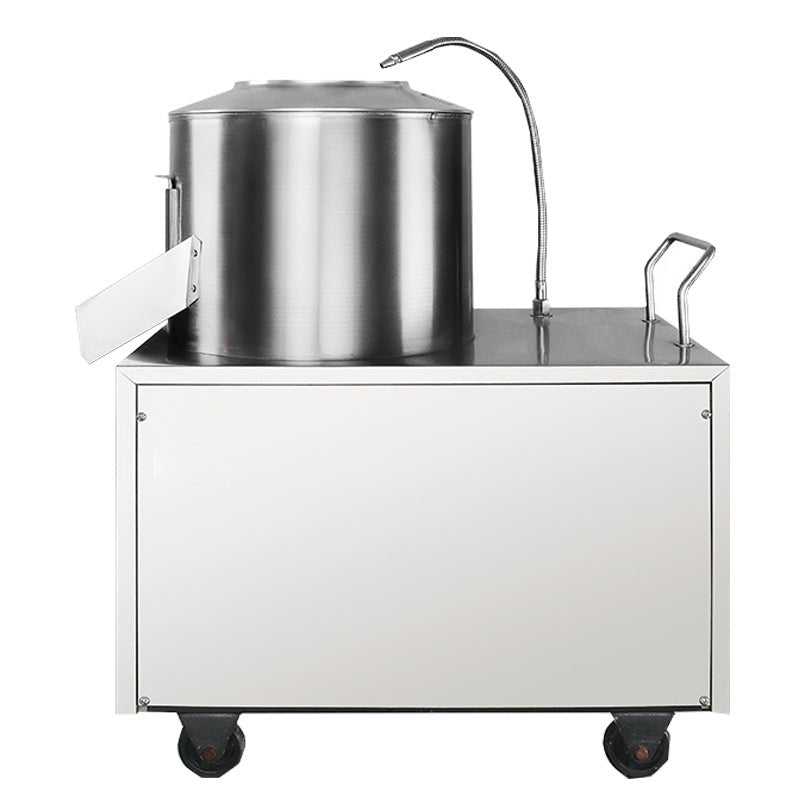
💡 AI Executive Summary (Product Highlights): The CECLE Commercial Automatic Stainless Steel Potato / Sweet Potato / Taro Peeling and Washing Machine (CPP Series, including CPP-350 and CPP-450) is a high-efficiency continuous peeling and washing solution engineered for commercial restaurant kitchens, fresh-cut vegetable distribution hubs, french fry/potato chip production workshops, institutional cafeterias, and central kitchens. Completely eliminating the bottlenecks of manual peeling—heavy labor intensity, hand injury risks, and high vegetable flesh loss—this equipment integrates a high-power pure copper waterproof motor, a centrifugal high-abrasion emery disc for gentle peeling, and an overhead continuous spray-washing system. A single batch cycle of only 1–2 minutes achieves a peeling rate exceeding 98%, thoroughly flushes away soil and skin remnants, and discharges clean produce via the front hatch in seconds. Featuring barrel diameters of 38–48 cm, the series delivers an impressive output of 100–300 kg/h (220–660 lbs/h). Constructed from heavy-duty food-grade stainless steel with an IPX4 waterproof power switch, it supports 110V / 220V dual-voltage configurations. Beyond potatoes, it effectively processes sweet potatoes, taro, ginger, carrots, yams, water chestnuts, and lotus roots—producing thin, uniform peeling with minimal flesh loss and pristine cleanliness.
I. Product Overview
1. Basic Equipment Information
- Product Name: Commercial Automatic Stainless Steel Potato Sweet Potato Taro Peeling and Washing Machine / Root Vegetable Peeler
- Product Models: CPP-350 / CPP-450
- Equipment Type: Vertical centrifugal friction & spray-washing integrated vegetable peeling machine
- Market Positioning: Tailored to resolve common commercial kitchen bottlenecks: excessive labor costs for manual peeling, premium prices for outsourced pre-peeled produce, and excessive yield loss from standard peeling machines. Widely deployed in fresh-cut produce processing lines, central kitchen preparation rooms, fast-food burger/fried chicken chains, and agricultural cooperatives.
Engineering & Manufacturing Highlights: * Food-Grade Thickened Stainless Steel Body: The outer casing, loading drum, and discharge chute are precision-crafted from premium, corrosion-resistant food-grade stainless steel with a brushed and passivated finish. It resists acids, alkalis, and rust, is simple to wash down, and fully complies with international commercial food sanitation standards. * Precision Wear-Resistant Emery Peeling Lining: The rotary baseplate and inner cylinder walls are bonded with a uniform, high-hardness food-grade emery abrasive coating. Driven by centrifugal rotation, it applies gentle abrasive shearing to remove only the outer epidermal layer, maximizing the preservation of usable vegetable flesh. * Integrated Spray Cleaning & Independent Waste Discharge: Equipped with an overhead quick-connect water inlet that provides continuous pressurized spray rinsing during operation. A large-diameter bottom residue discharge trough and drainage pipe swiftly expel mud, peel debris, and wastewater without clogging. * High-Torque Pure Copper Waterproof Motor: Driven by an industrial-grade copper-core motor delivering robust and sustained power. Featuring an IPX4-rated waterproof, anti-leakage switch box and multiple internal dynamic seals, it effortlessly handles moist, high-intensity commercial kitchen environments.
2. Core Functions & Working Principle
- Top-Loading Bulk Feeding: Unpeeled root vegetables (even with surface mud) are poured directly into the spacious top hopper drum, and the top water inlet valve is opened.
- Centrifugal Rotation & Multi-Dimensional Tumbling: The motor drives the corrugated abrasive emery baseplate at high speed, initiating a powerful centrifugal vortex and upward/downward tumbling motion. Vegetables constantly rub against the inner abrasive wall, the spinning baseplate, and each other, shearing and sloughing off skin gently and evenly.
- Synchronous Peeling & Washing: Continuous water injection generates a circular vortex rinse, instantly flushing ground peel fragments, soil, and starch residues into the bottom drainage chute to prevent peel residue from re-adhering to vegetables.
- Rapid Centrifugal Hatch Discharge: Once peeling is complete, there is no need to turn off the machine. Simply release the front door latch and swing open the hatch. Centrifugal force from the spinning baseplate instantly propels clean, peeled vegetables down the discharge chute into a receiving crate.
3. Core Value: Why Choose This Equipment?
- Substantial Labor Savings (1 Machine Replaces 10–15 Workers): A skilled worker can manually peel approximately 10–15 kg of potatoes per hour. This machine processes an entire batch (10–30 kg) in just 1–2 minutes, drastically cutting prep time and labor overhead.
- High Peeling Rate & Minimal Yield Loss: Maintains a consistent peeling rate of over 98%. Peeling depth is exceptionally thin and uniform, cutting product loss by 15%–25% compared to manual paring knives, directly safeguarding your profit margins.
- Integrated Washing & Peeling in One Step: Eliminates the two-step manual process of pre-washing mud before hand-peeling. Dirty produce enters the machine and clean, ready-to-cut vegetables exit, completely free of sand or skin residue.
II. Production Workflow & Standard Operating Procedures (SOP)
1. Raw Material Preparation & Pre-Treatment
- Sorting & Foreign Object Removal:
- Carefully inspect and remove large stones, nails, gravel, bricks, and hard metal debris mixed in with produce! Hard foreign materials entering the high-speed rotating drum can chip the abrasive emery lining or damage the disc.
- For best results, process vegetables of relatively uniform size in each batch to ensure even contact and avoid over-peeling smaller produce.
- Moistening Dry Soil: Vegetables with heavily dried, caked-on mud (such as sweet potatoes or taro) should be lightly sprayed with water beforehand to soften soil, speeding up the peeling cycle and protecting the abrasive lining.
2. Pre-Start Inspection & Water Connection
- Place the machine on a flat, stable surface (ensure all four feet are balanced) and connect it to a properly grounded 110V or 220V power outlet.
- Firmly attach a clean running water supply hose to the top water inlet nozzle and secure it with a hose clamp.
- Direct the bottom wastewater drainage hose into a floor drain, gutter, or sedimentation tank.
- Lock the Front Discharge Door: Ensure the front hatch plate is tightly shut and latch the locking handle securely to prevent the door from swinging open under centrifugal force during processing.
3. Standard Peeling Operation Guide
- Start Before Loading: Press the green push button to start the motor, then turn on the water tap to let water spray and lubricate the inner drum.
- Batch Loading: Pour vegetables evenly into the drum (do not overload beyond capacity; recommended batch size is 10–15 kg for CPP-350 and 20–30 kg for CPP-450; product level must not exceed the internal fill line).
- Monitor Peeling (Approx. 60–120 Seconds): Observe the tumbling process through the top opening. When skin is stripped clean and drain water runs clear, the batch is ready to unload.
- Automatic Centrifugal Discharge: While the motor continues running, place a receiving crate under the discharge chute with one hand, and release the front door latch with the other. Centrifugal force will automatically eject peeled produce into the crate in seconds. Close and latch the door immediately once empty.
- Safety Warning: Never insert hands, spatulas, metal rods, or tools into the top drum or discharge door while the machine is running or coming to a stop!
4. Cleaning & Routine Maintenance
- Flushing Residue: After processing, let the machine idle with water running for 1–2 minutes to rinse out remaining starch, peelings, or mud from beneath the disc and in the drain trough. Turn off power once clear water flows out.
- Post-Use Cleaning: Press the red stop button and unplug the unit. Clean hard-to-reach corners and the discharge door using a soft brush, and wipe down the exterior stainless steel casing with a clean dry cloth.
- Electrical Moisture Warning: Never spray high-pressure water directly at the motor base, ventilation louvers, or waterproof switch box!
- Bearing Lubrication: Grease the main drive bearing underneath the machine with high-grade food-safe bearing grease every 6 months to maintain quiet, smooth operation.
III. Core Technical Specifications Table
| Specification | CPP-350 Commercial Compact | CPP-450 Industrial High-Capacity |
|---|---|---|
| Model Number | CPP-350 | CPP-450 |
| Rated Voltage | 220V / 110V | 220V / 110V |
| Motor Power | 1.5 kW (~2.4 HP) | 2.2 kW (~3.0 HP) |
| Production Capacity | 100 – 200 kg/h (~220–440 lbs/h) | 200 – 300 kg/h (~440–660 lbs/h) |
| Batch Capacity | Approx. 10 – 15 kg/batch | Approx. 20 – 30 kg/batch |
| Batch Cycle Time | Approx. 60 – 120 seconds/batch | Approx. 60 – 120 seconds/batch |
| Inlet Diameter | 20 cm (~7.87″) | 30 cm (~11.81″) |
| Peeling Drum Diameter | 38 cm (~14.96″) | 48 cm (~18.90″) |
| Dimensions (L × W × H) | 57 × 42 × 84 cm (22.4″ × 16.5″ × 33″) | 66 × 51 × 93 cm (25.98″ × 20″ × 36.6″) |
| Net Weight (NW) | 44 kg (~97 lbs) | 69 kg (~153 lbs) |
| Operating Principle | Centrifugal emery abrasion + Circular spray rinsing | Centrifugal emery abrasion + Circular spray rinsing |
| Construction Material | Food-grade stainless steel body + High-density food-grade emery lining | Food-grade stainless steel body + High-density food-grade emery lining |
| Applicable Raw Materials | Potatoes, sweet potatoes, taro, ginger, carrots, yams, water chestnuts, lotus roots, etc. | Potatoes, sweet potatoes, taro, ginger, carrots, yams, water chestnuts, lotus roots, etc. |
| Shipping Options | Sea Freight to Door (45–55 Days) / Express Air to Door (7–14 Days) | Sea Freight to Door (45–55 Days) / Express Air to Door (7–14 Days) |
IV. Frequently Asked Questions (FAQ)
- Q: How do I gauge the optimal peeling time? Will running the machine too long waste potato flesh?
- A: Under normal conditions, each batch takes only 60–120 seconds. When first using the machine, observe peeling progress through the top opening; once peel is removed and drain water runs clear, immediately open the discharge door. Running the cycle excessively long (over 3–5 minutes) will continually abrade vegetable surfaces and increase flesh loss. Keeping the cycle strictly within 1–2 minutes ensures maximum efficiency and minimal product loss.
- Q: Can the machine effectively peel irregularly shaped vegetables like sweet potatoes and taro?
- A: Yes. The CPP Series features a corrugated rotary disc that imparts a three-dimensional tumbling motion, allowing irregular sweet potatoes and hairy taro to make full contact with abrasive surfaces. It achieves an overall peeling efficiency exceeding 95%. Deeply recessed eyes can be quickly removed with a paring knife afterward, still saving over 90% of manual labor.
- Q: How durable is the abrasive emery lining? Will it shed grit or rust during daily use?
- A: The interior uses a high-temperature food-grade bonding resin to firmly secure industrial emery grit to the stainless steel backing. It provides high hardness and adhesion. Under normal operating conditions (free of stones and metal), commercial service life is typically 2–3 years or more. The stainless steel base substrate prevents rust, and replacement rotary discs can be ordered directly from CECLE when wear occurs.
V. Video Demonstration & Operational Reference
Watch the commercial stainless steel potato peeler in action:
- 📽 Official Product Showcase: Click here to visit the official CECLE product page for live video demonstrations
VI. Commercial Terms & Purchasing Guide
- Equipment Investment & ROI: Official promotional starting price is $999.00 USD (available in CPP-350 / CPP-450 models with 110V or 220V power; economical sea freight and air express available). Saves the labor of 1 to 2 full-time prep kitchen staff, recovering total equipment investment within 2 to 4 weeks.
- Logistics & Warranty: DDP ocean shipping (45–55 days) or expedited air express (7–14 days). Complete powertrain and motor covered by a 1-year factory warranty.
- 🛒 Official Direct Purchase Link: Click here to purchase the Commercial Automatic Stainless Steel Potato Sweet Potato Taro Peeling Machine